


The Driver Pool Is Getting Tighter: How Fleet Operators Can Compete for Qualified Drivers
For fleet operators, the driver shortage is taking on a new dimension in 2026. Finding qualified CDL drivers was already one of the industry’s most persistent challenges, but a sweeping increase in federal enforcement is now removing drivers and operators from the available capacity pool. The Federal Motor Carrier Safety Administration has tightened enforcement of English-language proficiency requirements, restricted eligibility for non-domiciled CDLs, increased scrutiny of CDL issuance and training, and joined other federal agencies in targeted roadside enforcement efforts. In August, FMCSA reported that more than 26,000 commercial drivers had already been placed out of service for failing English-language proficiency requirements. Whatever a fleet operator’s view of these policies, the business consequence is becoming increasingly clear: the competition for qualified, compliant drivers is getting tougher.
That tightening is already showing up in the freight market. FreightWaves recently reported that J.B. Hunt is seeing driver recruitment needs at their highest level since 2022, while describing a driver market that has become noticeably harder as enforcement actions affect the available labor pool. The pressure extends beyond English-language proficiency and non-domiciled CDLs to increased scrutiny of driver schools, electronic logging device providers and other areas of trucking compliance. At the same time, federal and state authorities continue conducting large enforcement operations. During a three-day Midwest operation in late July, authorities issued roughly 766 out-of-service orders while targeting unqualified drivers, unsafe equipment and alleged licensing violations. This does not mean every driver removed from the road represents a driver a responsible fleet would have hired, but it does mean the overall capacity and labor landscape is changing.
For legitimate fleet operators, that can create some uncomfortable downstream effects. A truck without a qualified driver is not simply a recruiting problem. It is an asset that may be generating a payment, insurance expense, depreciation and other fixed costs without producing the revenue it was purchased or leased to generate. An open seat can mean missed routes, additional pressure on existing drivers, scheduling headaches and lost opportunities to expand the fleet. If enough operators encounter the same problem at once, the effects can spread throughout the market through tighter trucking capacity, increased rates and more competition for experienced drivers. Recent industry data is already pointing toward tighter capacity, with FreightWaves describing the current adjustment as increasingly supply-driven rather than the result of a sudden surge in freight demand.
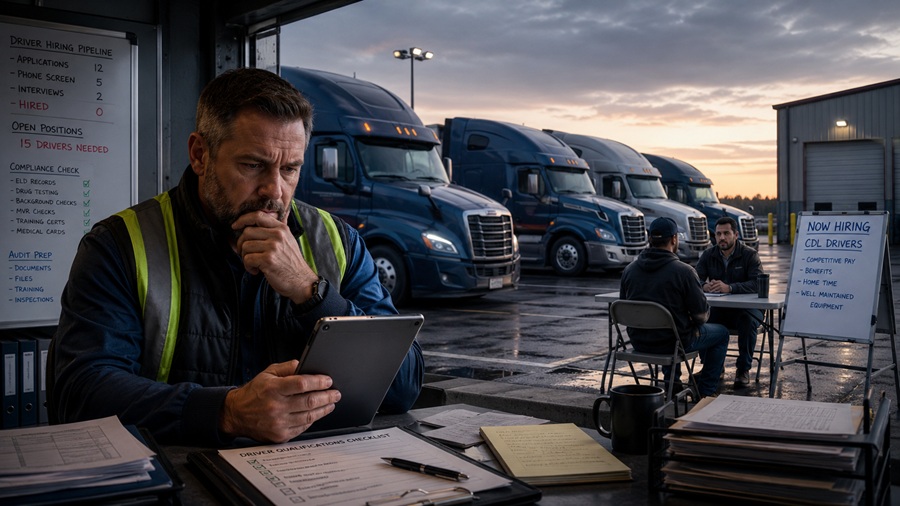
That means recruiting can no longer be something many fleets turn on only when a driver leaves. The old formula of posting an opening on a job board, waiting for applications and hoping a qualified candidate appears becomes increasingly risky when dozens of other fleets are chasing the same people. Driver recruitment needs to become an ongoing business function, much like maintenance, safety or customer acquisition. Even when every truck is seated, operators should be building a pipeline of potential drivers, keeping previous applicants engaged and continuously communicating why a professional driver should choose their operation instead of the fleet down the road. In a tightening labor market, the fleet that begins recruiting after a seat becomes empty may already be several weeks behind.
Fleet operators should also take a harder look at what they are actually selling to prospective drivers. Compensation matters, but recruiting cannot end with a cents-per-mile number or weekly pay estimate. Drivers are evaluating home time, equipment quality, route consistency, communication, safety culture, benefits, management and whether promises made during recruitment match the job they encounter after orientation. Fleets with late-model equipment, strong maintenance programs, predictable routes or better home-time arrangements should make those advantages prominent in their recruiting campaigns. And when fleets cannot lead the market on pay, they need to understand what other parts of the employment experience can differentiate them. A recruiting message that could belong to any trucking company is increasingly likely to disappear into the background noise.
Speed matters too. A strong CDL candidate may be talking with several employers simultaneously, which means slow follow-up can become an expensive habit. Fleet operators should examine the entire recruiting funnel: How quickly are new leads contacted? How difficult is the application? How many qualified applicants disappear between initial contact and an interview? How long does it take to move from application to offer and orientation? And does anyone follow up with a promising driver who wasn’t ready to move immediately? Recruiting technology and advertising can generate more leads, but they cannot compensate for a process that allows qualified drivers to sit untouched for days. In this market, recruiting is increasingly about conversion as much as lead generation.
This is also where specialized driver-recruitment partners can become valuable. Hire Impact, for example, focuses specifically on CDL driver acquisition and helps fleets build targeted campaigns designed to reach qualified drivers rather than simply adding another generic job posting to the pile. Using channels such as Meta and Indeed as part of a broader recruitment strategy can allow operators to target specific markets, test messages and continuously improve results based on which campaigns actually produce qualified candidates. For fleet owners who already have trucks, customers, routes and operations demanding their attention, outsourcing some of that recruiting expertise can be considerably more efficient than trying to become digital-recruitment specialists themselves.
The larger lesson for fleet operators is that driver availability is becoming another strategic capacity constraint that deserves the same attention as equipment availability, financing and maintenance. Federal enforcement is unlikely to disappear, and the industry’s renewed emphasis on driver qualifications means fleets should plan around a smaller, more competitive pool of candidates who meet the standards required to operate safely and legally. The operators positioned best for that environment will be the ones that recruit continuously, communicate a compelling employment proposition, respond quickly to candidates and treat driver retention with the same urgency as driver acquisition. Trucks may be the physical assets that move the freight, but in the market taking shape today, keeping qualified people behind the wheel could become one of the biggest competitive advantages a fleet has.
