


The Next Trucking Cycle May Be Driven by Supply, Not Demand
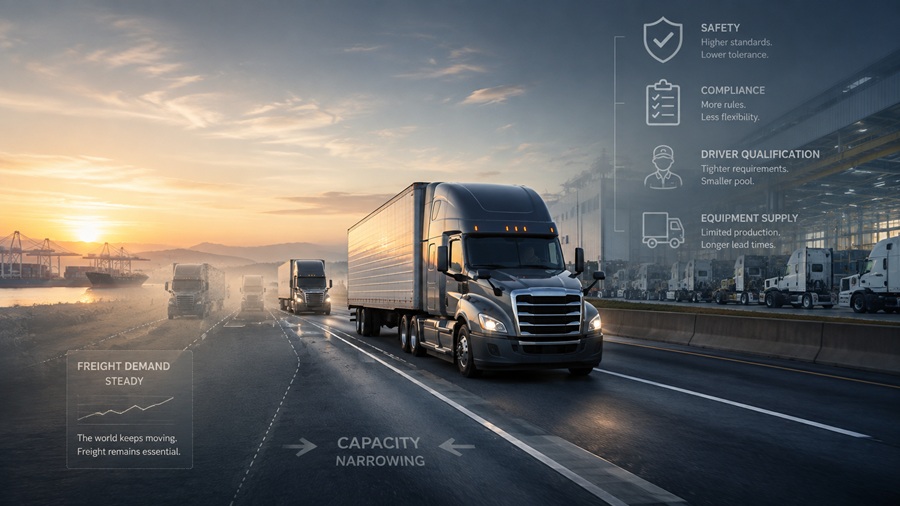
Stricter driver standards, greater scrutiny of carrier selection, shrinking capacity, and limited truck availability may be reshaping the industry from the supply side.
For most of trucking’s history, major market turns have been driven by freight demand. The COVID-era boom was a dramatic recent example. Consumers shifted spending from services toward physical goods, e-commerce surged, inventories moved rapidly, and carriers struggled to keep pace with extraordinary freight volumes. The share of retail sales conducted online jumped sharply during 2020, reaching 16.1 percent in the second quarter, according to the U.S. Census Bureau. When that surge faded, rates fell and excess capacity flooded the market. The next trucking cycle may develop in the opposite direction. Freight demand is not exploding, but the supply of qualified drivers, acceptable carriers, and available late-model trucks is becoming more constrained. Instead of more freight chasing the same number of trucks, the industry may soon have roughly the same freight chasing fewer viable trucks.
Recent market data supports this supply-side interpretation. ACT Research reports that the freight market tightened rapidly during the first half of 2026, even while shipment volumes remained mixed. ACT described the cycle as primarily supply-driven, with declining driver availability, contracting capacity, and enforcement changes tightening the market faster than freight demand alone would suggest. Truckload spot rates were on track to rise more than 40 percent year over year in June, excluding fuel. That is an unusual combination: rates are strengthening without a broad freight boom. The market is not necessarily being transformed by a mountain of new freight. It may be changing because the supply of dependable transportation is becoming harder to replace.
The legal environment could accelerate that change. In May, the U.S. Supreme Court ruled unanimously in Montgomery v. Caribe Transport II that federal law does not automatically block a state negligent-selection claim against C.H. Robinson for allegedly hiring an unsafe motor carrier. The ruling did not find C.H. Robinson liable, but it allowed the lawsuit to continue and confirmed that claims involving a broker’s selection of an unsafe carrier can fall within federal law’s motor-vehicle safety exception. The complete Supreme Court opinion is available here. Brokers now have a stronger reason to investigate and document the carriers they select, while shippers may place more pressure on brokers to demonstrate that those carriers were chosen responsibly. Operating authority and a low price may no longer be enough. Safety ratings, insurance, maintenance practices, driver qualifications, crash histories, and documented vetting procedures are likely to play a larger role in determining who receives freight.
At the same time, regulators are tightening the pipeline through which new commercial drivers enter the industry. The federal government has stepped up audits and investigations of CDL training providers, including schools accused of certifying students who did not receive adequate instruction. FMCSA announced in July that nearly 10,000 CDL training schools had been removed from its Training Provider Registry, while hundreds of additional providers had received notices of proposed removal. Eliminating sham schools should improve driver preparation and roadway safety over time. In the near term, however, it can slow the flow of new drivers into the industry and make it more difficult for carriers that relied on lightly supervised recruiting and training channels to replace departing employees.
Driver availability is also being affected by stricter enforcement of English-language proficiency and non-domiciled CDL requirements. English-proficiency violations were restored to the commercial-vehicle out-of-service criteria beginning in June 2025, meaning drivers who cannot satisfy the federal standard may be prohibited from continuing a trip until the violation is resolved. A separate FMCSA rule governing non-domiciled CDLs took effect in March 2026 and requires states that cannot meet the revised verification standards to pause the issuance of affected credentials. These policies should not be interpreted to mean that every foreign-born or non-domiciled driver is unqualified, nor does every out-of-service order permanently remove a driver from trucking. Collectively, however, stronger licensing, documentation, and roadside enforcement can reduce the number of drivers immediately available to operate commercial vehicles.
These changes are arriving after a long and difficult freight recession for many smaller carriers. Low rates, high insurance costs, expensive repairs, elevated financing expenses, and weak cash reserves have already pushed some companies toward the edge. Greater scrutiny from brokers, shippers, insurers, and regulators could now separate carriers not only by price, but by their ability to prove that they are professionally managed. Some companies with poor safety records or inadequate documentation may lose access to desirable freight or leave the market entirely. Other responsible carriers may also fail simply because they lack the capital to survive the transition. The likely result is a smaller pool of carriers that major brokers and shippers are comfortable hiring. This is an inference from the combined regulatory, legal, and capacity trends, but it fits ACT’s finding that available truckload capacity is contracting even without a major increase in freight demand.
For the carriers that remain, fleet quality will become increasingly important. A newer truck is not automatically safer than an older one, and a well-maintained older vehicle can still operate reliably. However, modern equipment is more likely to include collision-mitigation systems, electronic stability controls, lane-departure warnings, improved braking, cameras, telematics, and other technology that can help prevent accidents and document a carrier’s safety practices. The difficulty is that access to new Class 8 trucks is already constrained. FTR reports that most 2026 production is committed and that manufacturers have not fully opened their 2027 order boards. Uncertainty surrounding model-year 2027 EPA engine requirements adds another layer of pressure. The standards are scheduled to begin in model year 2027, although EPA proposed amendments in July that could change some compliance provisions. Concerns about future prices, unfamiliar technology, and equipment availability may encourage fleets to purchase earlier, adding pressure to already-limited production capacity.
Trucking may therefore be entering a rare structural transition in which the market’s usable supply of drivers, trusted carriers, and modern equipment tightens at the same time. Four years ago COVID changed trucking by creating an extraordinary temporary increase in freight demand. This cycle may change it by reducing the amount of capacity that brokers, shippers, insurers, and regulators consider acceptable. For fleet operators, waiting for a dramatic freight boom before planning equipment needs could be a costly mistake. Companies that secure dependable trucks, invest in safety technology, maintain strong records, and demonstrate disciplined operations may be best positioned to earn freight and protect their margins. For REL and its fleet partners, the opportunity is to help operators prepare for that transition before constrained equipment supply and rising demand for high-quality carriers turn preparation into a scramble.
