


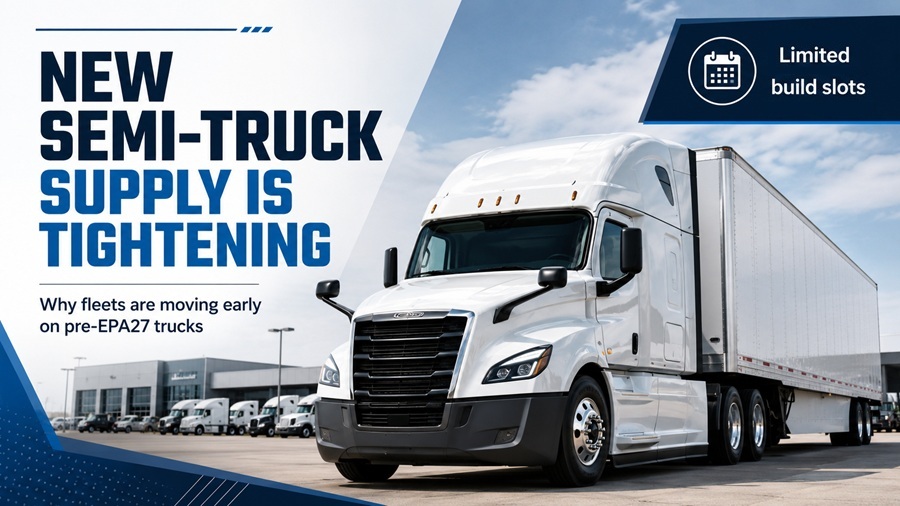
Why New Semi-Truck Supply Is Tightening in the Second Half of 2026
The market for new semi-trucks is tightening rapidly as the industry moves through the second half of 2026. Fleets that delayed replacement purchases during the prolonged freight downturn are returning to the market just as manufacturers approach the limits of their remaining 2026 production capacity. Firmer freight rates, aging equipment, reduced industry capacity and the approaching EPA27 emissions transition are all converging on the same order boards. For fleet owners and operators considering new equipment, the question is quickly shifting from whether truck prices might improve to whether the preferred truck, specification and delivery date will still be available.
June’s Class 8 order numbers show how dramatically the market has changed. FTR reported approximately 30,500 North American Class 8 net orders during June, up 241% from an exceptionally weak June 2025 and roughly 68% above the ten-year June average. It was the second-highest June order total since FTR began tracking the market. More importantly for buyers, FTR said the remaining 2026 build slots were likely to fill during July, if they had not filled already. The market is moving from an order-taking phase into a capacity-allocation phase, where dealer access to production slots can matter almost as much as customer demand.
Truck manufacturers cannot simply add thousands of units to their schedules overnight. Every additional build requires coordinated availability across engines, transmissions, axles, electronics, cabs, aftertreatment systems and hundreds of suppliers. Once an OEM’s schedule reaches capacity, late-arriving orders may be pushed into 2027 production, restricted to the specifications still available or placed behind customers who ordered earlier. Popular highway tractors and commonly requested configurations are likely to feel the squeeze first.
Kriete Truck Centers, Executive VP of Sales David Barletta tells us: “We’re seeing OEM order boards fill up fast as the new emission regulations approach, and that’s tightening up inventory heading into next year. If a truck replacement or fleet growth is on your radar, this is the window to act. The earlier you get in line, the more control you’ll have over specs, timing, and price.”
The largest accelerant is the approaching EPA27 transition. The stricter federal nitrogen-oxide standards remain scheduled to apply to model-year 2027 heavy-duty engines, even though the EPA proposed revisions in July that would ease portions of the original warranty, useful-life and compliance framework. The proposal could reduce some expected costs, and temporary nonconformance penalties may give manufacturers additional flexibility, but it does not erase the underlying emissions transition. The final cost difference remains uncertain, and fleets should not assume that the next generation of trucks will be priced the same as the current generation.
Manufacturers are already preparing their new engines, factories, dealers and service networks for the change. Volvo has introduced its next-generation D13 powertrain for the EPA27 standards taking effect January 1, 2027. Mack has announced that its EPA27-compliant MP13 will open for orders in August 2026, with production timed for model-year 2028 vehicles. These announcements do not mean every 2027 or 2028 truck is already being built, but they show that the industry is moving into the new equipment cycle now. Buyers placing orders during the second half of 2026 may therefore be choosing between limited current-generation availability and future production incorporating new emissions technology, engineering and compliance costs.
Driver availability is adding another layer of pressure. Stronger enforcement of English-language proficiency requirements and tighter eligibility rules for non-domiciled commercial driver’s licenses are reducing the number of drivers some carriers can legally place behind the wheel. This does not automatically mean every carrier will purchase more trucks, since a fleet will not expand equipment it cannot staff. However, fewer qualified drivers can remove marginal capacity from the freight market, support higher utilization and improve rates for compliant fleets that retain their drivers. ACT Research identifies lower driver availability, tighter capacity, firmer rates, replacement demand and EPA27 planning as overlapping supports for new-truck demand.
Adam Arrington, Lonestar Truck Group EVP of Sales & Marketing relates: “What we’re seeing right now isn’t just one thing — several pressures are hitting at once. OEMs pulled back production and tightened allocations after the emissions regulation changes, and that capacity hasn’t fully come back. The EPA2027 pre-buy also pulled orders forward, and we’re now in the lull that follows. Add ongoing chassis and component supply constraints, higher floorplan costs that make dealers more conservative about how much they stock, and soft freight rates keeping fleets on the sidelines — and you get a market where demand has cooled some, but available inventory has gotten more desirable and easier to move to retail customer.
Additional factors driving Freightliner and Western Star Vocational sales are the data centers and infrastructure spending that are driving vocational sales and the new Generation 5 Freightliner Cascadia that offers an 3% improvement in fuel efficiency and additional safety features with the Detroit Assurance 6.0.
All of these are driving orders and we are effectively sold out for CY 2026 available truck production.”
Waiting carries risks beyond the possibility of paying more for a future truck. An aging tractor may bring higher maintenance expenses, more downtime, weaker fuel economy and lower trade-in value. A fleet that waits until production capacity is fully committed may also lose control over specifications, financing timing and delivery schedules. Instead of ordering the truck best suited to its routes, drivers and maintenance operation, it may have to choose from whatever inventory or future build position remains. In a tightening market, the apparent savings from delaying a purchase can quickly be consumed by repairs, missed loads and equipment sitting in the shop rather than generating revenue.
Fleet owners do not need to panic-buy, but they should move from observation to planning now. Review replacement cycles, identify trucks approaching expensive maintenance intervals and ask dealers about actual factory availability rather than assuming last year’s lead times still apply. Fleets that order earlier will have a better chance of securing their preferred model, powertrain, specification, financing structure and delivery window. Those that wait until the shortage becomes obvious to everyone may find that the most desirable pre-EPA27 trucks are already spoken for, the remaining production has moved into a later model year and the cost of hesitation is considerably higher than the cost of acting today.
